Canada School of Public Service 2026–27 Departmental Plan
Description
This report presents the Canada School of Public Service's departmental plan for 2026–2027.
Published: February 13, 2026
Author: Canada School of Public Service
Copyright
Unless otherwise specified, you may not reproduce materials in this publication, in whole or in part, for the purposes of commercial redistribution without prior written permission from the Canada School of Public Service's copyright administrator.
To obtain permission to reproduce Government of Canada materials for commercial purposes, apply for Crown Copyright Clearance by contacting:
Canada School of Public Service
373 Sussex Dr.
Ottawa, ON K1N 6Z2
Canada
Telephone: 1-866-703-9598
Fax: 1-866-944-0454
Email: https://www.csps-efpc.gc.ca/contact_us/inquiries-eng.aspx
Website: Canada.ca/school-ecole
Cover photo: Environment and Climate Change Canada
Aussi disponible en français
At a Glance
This departmental plan details the Canada School of Public Service's priorities, plans, and associated costs for the upcoming three fiscal years.
These plans align with the priorities outlined in the Mandate Letter , as well as the School's Vision, mission, raison d'être and operating context.
Key priorities
The School identified the following key priorities for 2026‒27:
- Reskilling and upskilling public servants through a range of formats, from hands-on activities to practical training and cutting-edge events, with an aim to build the knowledge, skills, and abilities required for organizational agility and excellence in service design and delivery, and to foster inclusive practices that support responsiveness to emerging challenges and the generational shift that Canada is experiencing.
- Developing and delivering a common, Government of Canada-specific core curriculum that provides public service employees with the skills and competencies required for modern governance, thereby enabling them to exercise their accountabilities at all stages of their careers as stewards of public trust.
- Developing and delivering a comprehensive suite of executive learning and leadership programs and activities with experts, partners and next-generation speakers aimed at promoting innovative and inclusive thinking, developing forward-looking leaders, and enhancing the capacity to lead effectively in a dynamic and complex environment.
- Providing an expanding suite of learning products focused on reinforcing a digital-first mindset with an objective to increase artificial intelligence (AI), digital and data skillsets to support the Government of Canada's move towards improving productivity and service delivery.
Comprehensive Expenditure Review
The government is committed to restraining the growth of day-to-day operational spending to make investments that will grow the economy and benefit Canadians.
As part of meeting this commitment, the School is planning the following spending reductions:
- 2026‒27: $5,458,000
- 2027‒28: $7,277,000
- 2028‒29: $10,916,000
It is anticipated that these spending reductions will involve a decrease of approximately sixty‑six full‑time equivalents by 2028‒29.
The School will achieve these reductions by doing the following:
- Streamlining administration
- Narrowing research faculty
- Reducing management
- Leveraging technology
The figures in this departmental plan reflect these reductions.
Highlights for the School in 2026‒27
- The School will broaden the use of digital tools and automation to enhance service delivery, streamline manual processes, and improve operational efficiency. Key initiatives will include interactive self-service portals, chatbots, and automation technologies to strengthen back-office operations, simplify procedures, and maintain strong productivity as the public service becomes leaner.
- The School will ensure learning is aligned with government priorities and emerging public service needs, including: technology and digital-era competencies; responsible and strategic use of artificial intelligence; cyber security vigilance and data stewardship; national security, Arctic sovereignty, and resilience in a changing geopolitical environment; and adaptive service design for a diverse and evolving Canadian population. To achieve this, the School will work collaboratively with federal departments, territorial governments, Indigenous partners, the private sector, academia and other public institutions, drawing on subject-matter expertise to design cutting-edge, accessible, inclusive and future-ready learning experiences.
- The School will strengthen workforce readiness in effective AI, digital and data skillsets by providing learning paths through its Digital Academy, including hands-on facilitated experiences via the Design Bootcamp and the AI Executive Learning Accelerator Program. It will also host the GC Data Conference 2027 and convene a cross-departmental working group to prioritize and support delivery of an expanded suite of Government of Canada AI literacy and skills learning products.
- The School will emphasize the development of behavioural competencies including creativity, resilience, critical thinking, and emotional intelligence to strengthen a public service capable of thinking across boundaries and acting with coherence in times of change and to uphold integrity, trust and citizen-centred service as foundational values.
In 2026‒27, total planned spending (including internal services) for the School is $88,055,308 and total planned full-time equivalent staff (including internal services) is 623.
Summary of planned results
The following provides a summary of the results the department plans to achieve in 2026‒27 under its main area of activity, called “core responsibility.”
Core responsibility: Common public service learning
As the Government of Canada's common learning provider, the School will strengthen the capacity of federal public servants to deliver results through five key business lines:
The focus will be on providing common learning that is responsive, high-quality and accessible, and that enhances the public service's capacity to deliver results for Canadians.
Planned spending: $66,041,481
Planned human resources: 467
More information about common public service learning can be found in the full plan.
For complete information on the School's total planned spending and human resources, read the Planned spending and human resources section of the full plan.
From the Minister
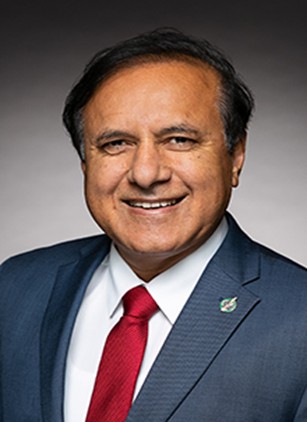 The Honourable Shafqat Ali, President of the Treasury Board
The Canada School of Public Service is the Government of Canada's common learning provider, delivering a wide range of courses, events, programs, and tools that foster a strong culture of learning across the federal public service. As the Minister responsible for the Canada School of Public Service, I am pleased to present the School's 2026–27 Departmental Plan.
In 2026–27, in support of a productive, innovative, and future ready public service, the School will expand its learning offerings in the digital domain, with new and enhanced products on data literacy, cybersecurity, artificial intelligence (AI), and other emerging digital technologies. These offerings will equip public servants with the skills and confidence needed to use new digital tools as part of their work routines, while ensuring their ethical and responsible application across government.
As part of the Government of Canada's efforts to increase productivity and reduce operational expenditures through the responsible use of AI, the School will further leverage this technology and harness data to improve how its learning products are designed, delivered and experienced. By modernizing its learning development processes, the School will be able to create content more efficiently across multiple formats, including text, web, video, podcasts, and interactive digital modules. The use of AI tools will also help to streamline internal systems, workflows, reduce duplication, and allow employees to focus their expertise on higher value work.
By applying a human centred approach to learning, and by advocating that effective leadership remains central to a high performing public service, the School will continue to adapt and strengthen its executive and leadership development programs to further support the strategic, managerial, and interpersonal capabilities required of today's leaders.
The School will equally continue to prioritize inclusion to ensure that its learning offerings meet the diverse needs of all public servants by integrating diverse perspectives into the design and delivery of its products. It will also expand its programming with products that will deepen one's understanding of how identity factors shape experiences of inclusion, equity, and opportunity in the workplace, and by extension, government programs and services.
Additionally, through strong partnerships and ongoing collaboration with departments, agencies, and subject matter experts, the School will ensure that its learning offerings remain relevant, accurate, and responsive to the changing needs of public servants as they strive to serve Canadians with excellence.
The Honourable Shafqat Ali, P.C., M.P.
President of the Treasury Board
Plans to deliver on core responsibility and internal services
Core responsibility and internal services
Core responsibility: Common public service learning
In this section
Description
The Canada School of Public Service provides common learning to all employees of the core public service to serve Canadians with excellence.
Quality of life impacts
The Quality of Life Framework for Canada highlights several domains that are closely aligned with the School's mandate. The School's common public service learning core responsibility supports the Framework's "Fairness and Inclusion" and "Sustainability and Resilience" lenses. This involves promoting continuous dialogue, critical thinking, and evidence-based policy-making; advancing the ethical use of artificial intelligence and responsible data governance rooted in values and ethics; enhancing awareness of Indigenous rights, cultures and perspectives; and addressing issues such as harassment, racism, and inclusion.
More notably, the School contributes to the "Good Governance," "Prosperity," "Health," and "Society" domains. It supports indicators such as "Confidence in institutions," "Representation in senior leadership positions," "Misinformation," "Indigenous self-determination," "Adult skills," "Productivity," "Perceived mental health," "Sense of pride in Canada," "Sense of belonging to Canada," and "Shared values." These outcomes are achieved through the delivery of common learning opportunities to employees across the core public administration.
Through the delivery of executive learning and leadership programs with leading-edge subject matter experts, the School is enhancing innovative thinking, developing forward-looking leaders, and building leadership capacity enterprise wide. These efforts reinforce the "Good Governance" domain by strengthening accountability and promoting alignment with government priorities.
Indicators, results and targets
This section presents details on the department's indicators, the actual results from the three most recently reported fiscal years, the targets and the target dates for common public service learning. Details are presented by departmental result.
Tables 1 to 4 provide a summary of the target and actual results for each indicator associated with the results under common public service learning.
Table 1: Common learning is responsive to learning needs
| Departmental result indicators |
Actual results |
2026-27 Target |
Date to achieve target |
| Percent of learning priorities addressed annually |
2022‒23: 94.2%
2023‒24: 82.5%Footnote 1
2024‒25: 83.7% |
80% |
March 31, 2027 |
| Percent of learning products updated in accordance with the product life-cycle plan |
2022‒23: 100%
2023‒24: 100%
2024‒25: 100%Footnote 2 |
80% |
March 31, 2027 |
|
|
Table 2: Quality common learning is provided to the core public service
| Departmental result indicators |
Actual results |
2026-27 Target |
Date to achieve target |
| Percent of learners who report that their common learning needs were met |
2022‒23: 84.3%
2023‒24: 86.4%
2024‒25: 87.1%Footnote 3 |
90% |
March 31, 2027 |
| Percent of supervisors who report improved performance of employees, in particular for those employees in management and leadership development programs |
2022‒23: 71.5%
2023‒24: 68.8%Footnote 4
2024‒25: 71.0% |
75% |
March 31, 2027 |
| Percent of learners who report that the facilitator/instructor was effective |
2022‒23: 95.2%
2023‒24: 96.6%
2024‒25: 96.7% |
95% |
March 31, 2027 |
|
|
Table 3: Common learning is accessible to all employees of the core public service
| Departmental result indicators |
Actual results |
2026-27 Target |
Date to achieve target |
| Percent of employees of the core public service who access common learning annually |
2022‒23: 75.5%
2023‒24: 73.3%
2024‒25: 90.2% |
65% |
March 31, 2027 |
| Percent of employees of the core public service in the National Capital Region who access common learning annually |
2022‒23: 58.7%
2023‒24: 58.6%
2024‒25: 73.0%Footnote 5 |
65% |
March 31, 2027 |
| Percent of employees of the core public service outside of the National Capital Region who access common learning annually |
2022‒23: 90.0%
2023‒24: 86.5%
2024‒25: 100%Footnote 6 |
55% |
March 31, 2027 |
|
|
Table 4: Strengthened capacity across the core public service to use innovative approaches
| Departmental result indicators |
Actual results |
2026-27 Target |
Date to achieve target |
| Number of demonstration and learning projects undertaken in collaboration with other departments and agencies each year |
2022‒23: 83
2023‒24: 33
2024‒25: 20Footnote 7 |
23 |
March 31, 2027 |
|
|
Additional information on the detailed results and performance information for the School's program inventory is available on GC InfoBase.
Plans to achieve results
The following section describes the planned results for common public service learning in 2026‒27.
1. Common learning is responsive to learning needs
Results we plan to achieve
The School's mandate will be delivered through five business lines:
- The Digital Academy business line will build learning to support public servants with the AI, digital and data skillsets needed to create and leverage digital solutions to enhance productivity and improve service delivery. Learning will align with the Government of Canada's Digital Ambition, AI Strategy, and Data Strategy, and will be grounded in the Government of Canada's foundational digital competencies as well as across domains such as AI, data, service design, and cybersecurity.
- The Government of Canada and Public Sector Skills business line will strengthen public servants' understanding of their accountabilities and responsibilities, including orientation for new employees, foundational training on values and ethics, and functional training in delegated authorities across human resources, finance, and procurement.
- The Indigenous Learning business line will support the fulfilment of obligations related to reconciliation and the implementation of the United Nations Declaration on the Rights of Indigenous Peoples Act. Guided by government priorities and the Truth and Reconciliation Commission's Calls to Action, the business line will strengthen understanding, accountability, and cultural competencies.
- The Respectful and Inclusive Workplace business line will advance equity, diversity, and inclusion, aligned with legislative and policy frameworks and the "Nothing Without Us" approach. Focus will include Gender-based Analysis Plus, unconscious bias, addressing systemic racism and discrimination, accessibility, 2SLGBTQIA+ inclusion, healthy workplaces, mental health, harassment and violence prevention and countering hate. A priority will be delivering learning to address anti-Black racism and supporting the implementation of Canada's Black Justice Strategy.
- The Transferable Skills business line will help public servants develop skills and mindsets that are essential for public servants to deliver, lead, and adapt to the evolving needs of government. Focus will be placed on leadership and management, including project delivery and risk, as well as on decision-making and information integrity.
2. Quality common learning is provided to the core public service
Results we plan to achieve
- The School will develop clear learning maps and pathways for learners, including executives and managers, to take personal accountability for upskilling and reskilling. This includes delivering practical, multi-format learning products to adapt to emerging technologies, enhance productivity and improve service delivery for Canadians. Priority areas will include data, AI, cloud computing, cyber security, service design, product management, and agile practices.
- The School will continue to assess its learning products against industry standards through compliance and quality diagnostics, providing actionable recommendations to strengthen efficiency and overall effectiveness.
- The School will continue to work in close partnership with important stakeholders and subject matter experts. This includes experts from government (federal, provincial and municipal), academics, community partners, Indigenous partners, Elders, Knowledge Keepers, and subject matter experts from the private sector. This commitment will ensure rigorous content development and cutting-edge authentic and verifiable curricula.
3. Common learning is accessible to all employees of the core public service
Results we plan to achieve
- The School will enhance accessibility by integrating new tools and technologies that ensure full access to information and communication technologies, along with the training needed to use them effectively.
- The School will follow its Accessibility Plan 2026–2028, which outlines concrete actions to reduce accessibility barriers. These actions include conducting accessibility monitoring, strengthening the learning product review cycle, and integrating modern learning approaches such as gamification, neurolearning, and personalized learning into School products.
- The School will leverage AI to support course design and content development, enabling the swift creation of diverse learning formats, such as videos, podcasts, interactive modules, and text-based resources, customized to individual preferences and accessibility needs. This approach will ensure that learners have timely, relevant, and engaging educational experiences in the formats that work best for them.
4. Strengthened capacity across the core public service to use innovative approaches
Results we plan to achieve
- The School will equip public servants to responsibly and ethically apply digital tools and design thinking to drive innovation and adaptability, improving programs, policies, and services for Canadians. Training will encompass digital technologies, data and AI, emerging trends, innovation and adaptability, and digital leadership, supporting the Government of Canada's commitment to digital transformation and ongoing enhancement of public service delivery.
- The School will expand its executive and leadership programs to further strengthen the strategic, managerial, and interpersonal capabilities of public service leaders. These learning experiences will focus on systems thinking, collaboration, creativity, innovation, managing change, accountabilities, service and project delivery, digitization, emerging technologies and ensuring executives, managers and future leaders are well equipped to guide organizations in a rapidly evolving environment.
- The School will continue to develop AI powered toolkits on its main learning platform to accelerate course development, reduce time spent navigating content, improve learner engagement, and ensure a consistent, personalized, and high-quality learning experience.
Gender-based Analysis Plus
The School will continue to develop learning products that are inclusive and consider factors such as gender, race, ethnicity, sexual orientation, and other identity considerations, while integrating these diverse perspectives into outcome evaluations. The School will maintain its development and delivery of learning products that support Government of Canada organizations in applying Gender-based Analysis Plus (GBA Plus).
The School will build on the results of its collaboration with Women and Gender Equality Canada to address learning gaps in the public service related to gender and diversity. Drawing on the findings from this work, the School is developing learning products on intersectionality to strengthen public servants' understanding of how identity factors influence experiences of inclusion, equity, and opportunity in the workplace and in the programs, services and initiatives for people in Canada. These learning products will complement and enhance the application of GBA Plus across federal programs, services, and initiatives.
Through these efforts, the School will continue to advance the Government of Canada's commitments under the Canadian Gender Budgeting Act and contribute to the Sustainable Development Goals, particularly Goal 5 (Gender Equality) and Goal 10 (Reduced Inequalities), by promoting equitable learning opportunities and fostering an inclusive culture within the public service.
To assess the impacts of its learning offerings on gender and diversity, the School will continue to collect, analyze and apply both quantitative and qualitative learner feedback to guide continuous improvements. Feedback will be gathered through:
- learner surveys, questionnaires, and focus groups
- user testing during product development
- pilot offerings prior to full launch
- evaluation data from courses and events, incorporating both quantitative and qualitative insights
The School is also conducting a privacy impact assessment to ensure compliance and to safeguard personal information as it prepares to update learner profiles. These changes will enable the collection of voluntary demographic and intersectional data, allowing for more robust analysis of equity, diversity, and inclusion outcomes across its learning offerings.
Planned resources to achieve results
Table 5: Planned resources to achieve results for common public service learning
Table 5 provides a summary of the planned spending and full-time equivalents required to achieve results
| Resource |
Planned |
| Spending |
66,041,481 |
| Full-time equivalents |
467 |
Complete financial and human resources information for the School's program inventory is available on GC InfoBase.
Program inventory
Common public service learning is supported by the following programs:
- Learning
- Internal Services
Additional information related to the program inventory for common public service learning is available on the Results page on GC InfoBase.
Internal services
Description
Internal services are the services that are provided within a department so that it can meet its corporate obligations and deliver its programs. There are 10 categories of internal services:
- acquisition management services
- communications services
- financial management services
- human resources management services
- information management services
- information technology services
- legal services
- material management services
- management and oversight services
- real property management services
Plans to achieve results
This section presents details the department's plans to achieve results and meet targets for internal services.
The School will leverage technology across its operations to increase productivity, reduce duplication, and streamline administrative support. Initiatives will include generating real-time analytics dashboards and improving service delivery through self-service portals. These technologies will simplify workflows, allowing staff to focus on more meaningful work. In parallel, the School will reduce management layers to flatten its hierarchy, include diverse voices and share insights more openly. A leaner organizational structure will also support faster, more effective decision-making.
Planned resources to achieve results
Table 6: Planned resources to achieve results for internal services this year
Table 6 provides a summary of the planned spending and full-time equivalents required to achieve results
| Resource |
Planned |
| Spending |
22,013,827 |
| Full-time equivalents |
156 |
Complete financial and human resources information for the School's program inventory is available on GC InfoBase.
Planning for contracts awarded to Indigenous businesses
The School is committed to supporting Indigenous businesses through its procurement activities. Working with Shared Services Canada and Public Services and Procurement Canada, the School will prioritize Indigenous businesses for procurement requests, primarily in the areas of IT procurement.
Table 7: Percentage of contracts planned and awarded to Indigenous businesses
Table 7 presents the current, actual results with forecasted and planned results for the total percentage of contracts the department awarded to Indigenous businesses
| 5% Reporting field |
2024‒25 Actual result |
2025‒26 Forecasted result |
2026‒27 Planned result |
| Total percentage of contracts with Indigenous businesses |
8.4% |
5% |
5% |
Department-wide considerations
In this section
Related government priorities
United Nations 2030 Agenda for Sustainable Development and the UN Sustainable Development Goals
The School supports the UN 2030 Agenda for Sustainable Development through its mandate to develop a skilled, inclusive, and future-ready public service. In 2026‒27, it will further Canada's Federal Implementation Plan for the 2030 Agenda by:
- contributing to UN Sustainable Development Goal 4 (Quality Education) by offering accessible, high-quality learning opportunities for public servants, promoting lifelong learning and professional development.
- advancing Goal 10 (Reduced Inequalities) by integrating diversity, equity, and inclusion into its programs as well as offering courses, events and resources to increase awareness of the history, cultures, and realities of First Nations, Inuit and Métis in Canada, supporting reconciliation with Indigenous Peoples.
- supporting Goals 12 (Responsible Consumption and Production) and 13 (Climate Action) by providing courses on climate change, sustainable policy, and green government operations.
- advancing Goal 9 (Industry, Innovation and Infrastructure) by embedding digital literacy, AI ethics, and responsible innovation into its curriculum, thereby strengthening resilience and trust in government operations.
Within the organization, the School will reinforce its commitment to sustainability by expanding digital-first practices, modernizing workplaces, and minimizing waste and travel. These measures align with its Departmental Sustainable Development Strategy and support the goals outlined in Canada's Federal Implementation Plan.
More information on the School's contributions to Canada's Federal Implementation Plan for the 2030 Agenda and the Federal Sustainable Development Strategy can be found in its Departmental Sustainable Development Strategy.
Artificial intelligence
Preparing the workforce and organization for AI adoption remains a core priority for the School. The School will strengthen AI, digital, and data capabilities through curated learning paths, hands-on programs, executive learning, and government-wide AI literacy initiatives. These efforts will help the public service responsibly leverage AI to boost productivity, reduce costs, improve service delivery, and fulfill organizational mandates while upholding public sector values and ethics.
In support of the AI Strategy for the Federal Public Service 2025-2027, the School will continue to lead a cross-government working group to prioritize and support delivery of an expanded suite of Government of Canada AI literacy and skills learning products. Through targeted learning products, tailored learning paths, hands-on experiential learning and enhanced leadership training, organizations will be enabled to leverage AI to drive efficiency, improve services, and achieve organizational objectives, all while maintaining strong governance, ethical standards, and responsible stewardship of resources.
Planned spending and human resources
This section provides an overview of the School's planned spending and human resources for the next three fiscal years and of planned spending for 2026–27 with actual spending from previous years.
In this section
Spending
This section presents an overview of the department's planned expenditures from 2023‒24 to 2028‒29.
Budgetary performance summary
Table 8: Three-year spending summary for core responsibilities and internal services (dollars)
Table 8 presents the School's spending over the past three years to carry out its core responsibility and for internal services. Amounts for the 2025–26 fiscal year are forecasted based on spending to date.
| Core responsibility and internal services |
2023‒2024 Actual Expenditures |
2024‒2025 Actual Expenditures |
2025‒2026 Forecast Spending |
| Common public service learning |
68,650,218 |
71,018,720 |
87,755,195 |
| Subtotal |
68,650,218 |
71,018,720 |
87,755,195 |
| Internal services |
26,126,943 |
27,762,610 |
29,251,731 |
| Total |
94,777,161 |
98,781,330 |
117,006,926 |
Analysis of the past three years of spending
A higher spending level in the last three years is mainly attributable to the reprofile funding for the Advanced Leadership Program initiative, the new funding for the Canada's Black Justice Strategy and the Black Leadership Program, the increase in the forecasted respendable revenues in accordance with subsection 18(2) of the Canada School of Public Service Act. and the increase acquisition of licenses for online learning products.
More financial information from previous years is available on the Finances section of InfoBase.
Table 9: Planned three-year spending on core responsibilities and internal services (dollars)
Table 9 presents how much money the School plans to spend over the next three years to carry out its core responsibility and for internal services.
| Core responsibility and internal services |
2026‒27 Planned Spending |
2027‒28 Planned Spending |
2028‒29 Planned Spending |
| Common public service learning |
66,041,481 |
62,775,947 |
60,211,798 |
| Subtotal |
66,041,481 |
62,775,947 |
60,211,798 |
| Internal services |
22,013,827 |
20,925,316 |
20,070,599 |
| Total |
88,055,308 |
83,701,263 |
80,282,397 |
Analysis of the next three years of spending
Over the next three-year planning period, the spending is anticipated to decrease due to the Comprehensive Expenditure Review initiative and, the sunsetting of funding for both the Advanced Leadership Program and the Canada's Black Justice Strategy. The School will invest in its digital learning platform to ensure it remains modern, meets the needs of public service employees and reflects governmental priorities.
More detailed financial information on planned spending is available on the Finances section of GC Infobase.
Funding
This section provides an overview of the department's voted and statutory funding for its core responsibility and for internal services. For further information on funding authorities, consult the Government of Canada budgets and expenditures.
Graph 1: Approved funding (statutory and voted) over a six-year period
Graph 1 summarizes the department's approved voted and statutory funding from 2023‒24 to 2028‒29.
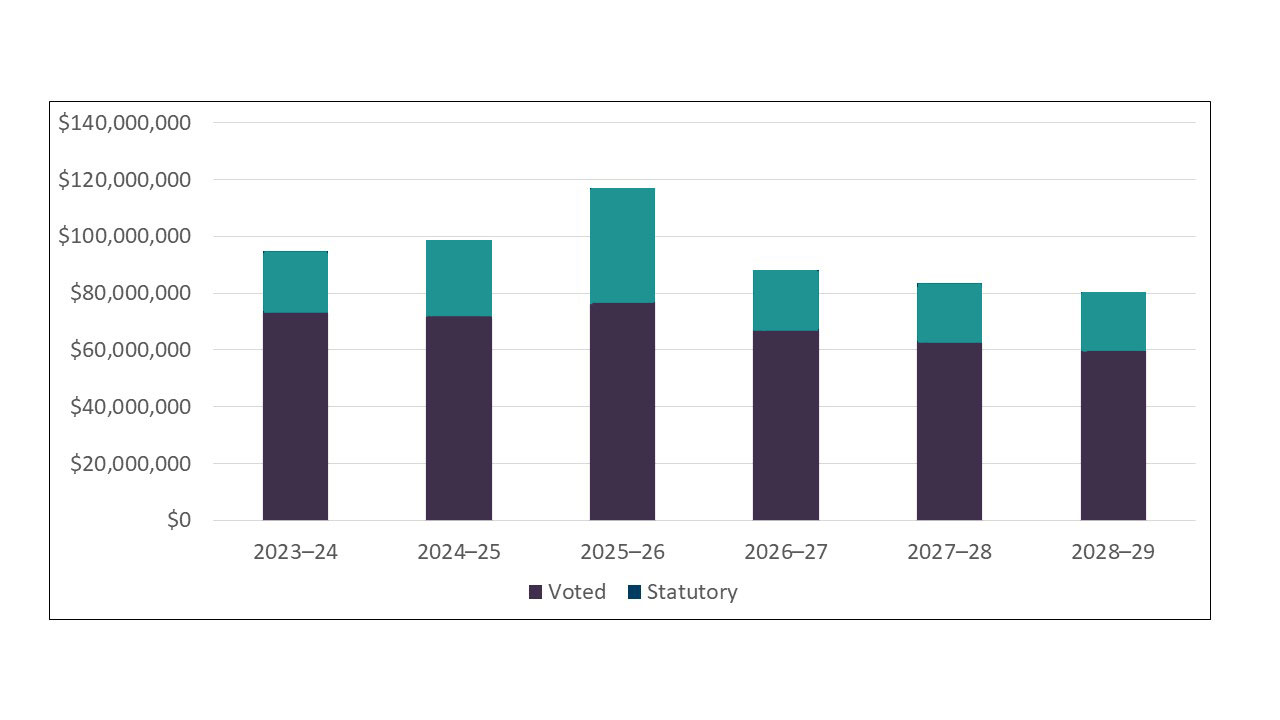
Text description of graph 1
| Fiscal year |
Total |
Voted |
Statutory |
| 2023‒24 |
94,777,161 |
73,086,025 |
21,691,136 |
| 2024‒25 |
98,781,330 |
71,862,495 |
26,918,835 |
| 2025‒26 |
117,006,926 |
76,490,772 |
40,516,154 |
| 2026‒27 |
88,055,308 |
66,678,116 |
21,377,192 |
| 2027‒28 |
83,701,263 |
62,617,231 |
21,084,032 |
| 2028‒29 |
80,282,397 |
59,656,112 |
20,626,285 |
Analysis of statutory and voted funding over a six-year period
Statutory spending is comprised of employee benefit plans, unspent revenues carried forward from the previous fiscal, in accordance with subsection 18(2) of the Canada School of Public Service Act, and respendable revenues pursuant to subsection 29.1(1) of the Financial Administration Act.
Planned spending will decrease over the next three years due to the Comprehensive Expenditure Review initiative and, the sunsetting of funding for both the Advanced Leadership Program and the Canada's Black Justice Strategy. The School will continue to invest in its digital learning platform to ensure it remains modern and meets the needs and expectation of learners.
For further information on the School's departmental appropriations, consult the 2026‒27 Main Estimates.
Future-oriented condensed statement of operations
The future-oriented condensed statement of operations provides an overview of the School's operations for 2025‒26 to 2026‒27.
Table 10: Future-oriented condensed statement of operations for the year ended March 31, 2027 (dollars)
Table 10 summarizes the expenses and revenues which net to the cost of operations before government funding and transfers for 2025‒26 to 2026‒27. The forecast and planned amounts in this statement of operations were prepared on an accrual basis. The forecast and planned amounts presented in other sections of the Departmental Plan were prepared on an expenditure basis. Amounts may therefore differ.
| Financial information |
2025‒26 Forecast results |
2026‒27 Planned results |
Difference (planned results minus forecasted) |
| Total expenses |
130,249,741 |
101,598,609 |
(28,651,132) |
| Total revenues |
30,365,565 |
11,130,872 |
(19,234,693) |
| Net cost of operations before government funding and transfers |
99,884,176 |
90,467,737 |
(9,416,439) |
Analysis of forecasted and planned results
Total expenses include amortization costs and costs related to services received without charge for accommodations, as well as the employer's contribution to employee benefit plans. Total expenses exclude those related to the acquisition of capital assets.
The decrease in the net cost of operations is mainly due to the reduction in budget due to the Comprehensive Expenditure Review initiative, the sunsetting of funding for the Advanced Leadership Program and, a decrease in revenue pursuant to subsection 18(2) of the Canada School of Public Service Act as the School does not forecast revenue carry-forward as part of planned results.
A more detailed Future-Oriented Statement of Operations and associated Notes for 2026‒27, including a reconciliation of the net cost of operations with the requested authorities, is available on the School's website.
Human resources
This section presents an overview of the department's actual and planned human resources from 2023‒24 to 2028‒29.
Table 11: Actual human resources for core responsibilities and internal services
Table 11 shows a summary of human resources, in full-time equivalents, for the School's core responsibility and for its internal services for the previous three fiscal years. Human resources for the current fiscal year are forecasted based on year to date.
| Core responsibility and internal services |
2023‒24 Actual full-time equivalents |
2024‒25 Actual full-time equivalents |
2025‒26 Forecasted full-time equivalents |
| Common public service learning |
491 |
459 |
490 |
| Subtotal |
491 |
459 |
490 |
| Internal services |
189 |
155 |
163 |
| Total |
680 |
614 |
653 |
Analysis of human resources over the last three years
The number of FTEs decreased in the last three years due to the Refocusing on Government Spending initiative, reduction of employee by attrition and, the accomplishment of operational efficiencies.
Table 12: Human resources planning summary for core responsibilities and internal services
Table 12 shows information on human resources, in full-time equivalents, for the School's core responsibility and for its internal services planned for the next three years.
| Core responsibility and internal services |
2026‒27 Planned full-time equivalents |
2027‒28 Planned full-time equivalents |
2028‒29 Planned full-time equivalents |
| Common public service learning |
467 |
458 |
440 |
| Subtotal |
467 |
458 |
440 |
| Internal services |
156 |
153 |
147 |
| Total |
623 |
611 |
587 |
Analysis of human resources for the next three years
The number of planned FTEs is expected to decrease over the next three years as a result of the Refocusing on Government Spending and the Comprehensive Expenditure Review initiatives.
Supplementary information table
Information on the School's departmental sustainable development strategy can be found on the School's website.
Federal tax expenditures
The School's Departmental Plan does not include information on tax expenditures.
The tax system can be used to achieve public policy objectives through the application of special measures such as low tax rates, exemptions, deductions, deferrals and credits. The Department of Finance Canada publishes cost estimates and projections for these measures each year in the Report on Federal Tax Expenditures.
This report also provides detailed background information on tax expenditures, including descriptions, objectives, historical information and references to related federal spending programs as well as evaluations and GBA Plus of tax expenditures.
Corporate information
Departmental profile
Appropriate minister: The Honourable Shafqat Ali, President of the Treasury Board
Institutional head: Taki Sarantakis, President
Ministerial portfolio: Treasury Board
Enabling instrument: Canada School of Public Service Act, S.C. 1991, c. 16
Year of incorporation / commencement: 2004
Departmental contact information
Mailing address
Canada School of Public Service
373 Sussex Drive
Ottawa, Ontario K1N 6Z2
Canada
Telephone: 1-866-703-9598
Fax: 1-866-944-0454
Email: https://www.csps-efpc.gc.ca/contact_us/inquiries-eng.aspx
Website: https://www.csps-efpc.gc.ca
Definitions
Definitions
appropriation (crédit)
Any authority of Parliament to pay money out of the Consolidated Revenue Fund.
budgetary expenditures (dépenses budgétaires)
Operating and capital expenditures; transfer payments to other levels of government, departments or individuals; and payments to Crown corporations.
core responsibility (responsabilité essentielle)
An enduring function or role performed by a department. The intentions of the department with respect to a core responsibility are reflected in one or more related departmental results that the department seeks to contribute to or influence.
Departmental Plan (plan ministériel)
A report on the plans and expected performance of an appropriated department over a 3year period. Departmental Plans are usually tabled in Parliament each spring.
departmental result (résultat ministériel)
A consequence or outcome that a department seeks to achieve. A departmental result is often outside departments' immediate control, but it should be influenced by program-level outcomes.
departmental result indicator (indicateur de résultat ministériel)
A quantitative measure of progress on a departmental result.
departmental results framework (cadre ministériel des résultats)
A framework that connects the department's core responsibilities to its departmental results and departmental result indicators.
Departmental Results Report (rapport sur les résultats ministériels)
A report on a department's actual accomplishments against the plans, priorities and expected results set out in the corresponding Departmental Plan.
full-time equivalent (équivalent temps plein)
A measure of the extent to which an employee represents a full person-year charge against a departmental budget. For a particular position, the full-time equivalent figure is the ratio of number of hours the person actually works divided by the standard number of hours set out in the person's collective agreement.
gender-based analysis plus (GBA Plus) (analyse comparative entre les sexes plus [ACS Plus])
Is an analytical tool used to support the development of responsive and inclusive policies, programs, and other initiatives. GBA Plus is a process for understanding who is impacted by the issue or opportunity being addressed by the initiative; identifying how the initiative could be tailored to meet diverse needs of the people most impacted; and anticipating and mitigating any barriers to accessing or benefitting from the initiative. GBA Plus is an intersectional analysis that goes beyond biological (sex) and socio-cultural (gender) differences to consider other factors, such as age, disability, education, ethnicity, economic status, geography (including rurality), language, race, religion, and sexual orientation.
Using GBA Plus involves taking a gender- and diversity-sensitive approach to our work. Considering all intersecting identity factors as part of GBA Plus, not only sex and gender, is a Government of Canada commitment.
government priorities (priorités gouvernementales)
For the purpose of the 2026‒27 Departmental Plan, government priorities are the high-level themes outlining the government's agenda in the 2025 Speech from the Throne.
horizontal initiative (initiative horizontale)
An initiative where two or more federal departments are given funding to pursue a shared outcome, often linked to a government priority.
Indigenous business (entreprise autochtone)
Requirements for verifying Indigenous businesses for the purposes of the departmental result report are available through the Indigenous Services Canada Mandatory minimum 5% Indigenous procurement target website.
non‑budgetary expenditures (dépenses non budgétaires)
Non-budgetary authorities that comprise assets and liabilities transactions for loans, investments and advances, or specified purpose accounts, that have been established under specific statutes or under non-statutory authorities in the Estimates and elsewhere. Non-budgetary transactions are those expenditures and receipts related to the government's financial claims on, and obligations to, outside parties. These consist of transactions in loans, investments and advances; in cash and accounts receivable; in public money received or collected for specified purposes; and in all other assets and liabilities. Other assets and liabilities, not specifically defined in G to P authority codes are to be recorded to an R authority code, which is the residual authority code for all other assets and liabilities.
performance (rendement)
What a department did with its resources to achieve its results, how well those results compare to what the department intended to achieve, and how well lessons learned have been identified.
performance indicator (indicateur de rendement)
A qualitative or quantitative means of measuring an output or outcome, with the intention of gauging the performance of a department, program, policy or initiative respecting expected results.
plan (plan)
The articulation of strategic choices, which provides information on how a department intends to achieve its priorities and associated results. Generally, a plan will explain the logic behind the strategies chosen and tend to focus on actions that lead to the expected result.
planned spending (dépenses prévues)
For Departmental Plans and Departmental Results Reports, planned spending refers to those amounts presented in Main Estimates.
A department is expected to be aware of the authorities that it has sought and received. The determination of planned spending is a departmental responsibility, and departments must be able to defend the expenditure and accrual numbers presented in their Departmental Plans and Departmental Results Reports.
program (programme)
Individual or groups of services, activities or combinations thereof that are managed together within the department and focus on a specific set of outputs, outcomes or service levels.
program inventory (répertoire des programmes)
Identifies all the department's programs and describes how resources are organized to contribute to the department's core responsibilities and results.
result (résultat)
A consequence attributed, in part, to a department, policy, program or initiative. Results are not within the control of a single department, policy, program or initiative; instead they are within the area of the department's influence.
statutory expenditures (dépenses législatives)
Expenditures that Parliament has approved through legislation other than appropriation acts. The legislation sets out the purpose of the expenditures and the terms and conditions under which they may be made.
target (cible)
A measurable performance or success level that a department, program or initiative plans to achieve within a specified time period. Targets can be either quantitative or qualitative.
voted expenditures (dépenses votées)
Expenditures that Parliament approves annually through an appropriation act. The vote wording becomes the governing conditions under which these expenditures may be made.
- Date modified:
